eTVnet - streaming service
Fixing a broken subscription flow = Increasing conversion rate
Business Goal
The primary business goal was to increase subscription conversion by removing friction from the journey of users who had already selected a plan and demonstrated purchase intent.
Scope
The project focused on improving the end-to-end subscription journey, including the registration and login flow initiated after plan selection, as well as the redesign of the checkout page.
year
2026
timeframe
1 month
tools
Figma
category
UX\UI Design
The Problem
A user who selects a subscription plan has already demonstrated strong purchase intent. At this critical point, the experience should guide them smoothly through account creation and payment. Instead, the existing flow creates a major barrier precisely when the user is ready to convert.
When an unauthorised user attempts to purchase a plan, they are met with an error message stating that they must be logged in. The modal offers only two options: Log In or Close, with no clear path for a new customer to register and continue. Even existing users who log in are redirected back to the homepage, losing the plan they originally selected and forcing them to repeat the process manually.
What should be a simple journey — Select a Plan → Register or Log In → Complete Payment — becomes a broken loop filled with unnecessary actions, uncertainty, and cognitive load. This case study explores how the subscription flow can be redesigned to preserve user intent, remove dead ends, and create a faster, more intuitive path to checkout.
The Solution
Improved flow
Within one month, our team launched a redesigned subscription and registration flow that removed the broken logic and unnecessary steps in the original journey.
Instead of blocking unauthorised users with an error, the new flow guided them directly into registration or login while preserving their selected subscription plan. After completing authentication, users could continue seamlessly to checkout without returning to the homepage or repeating previous actions.
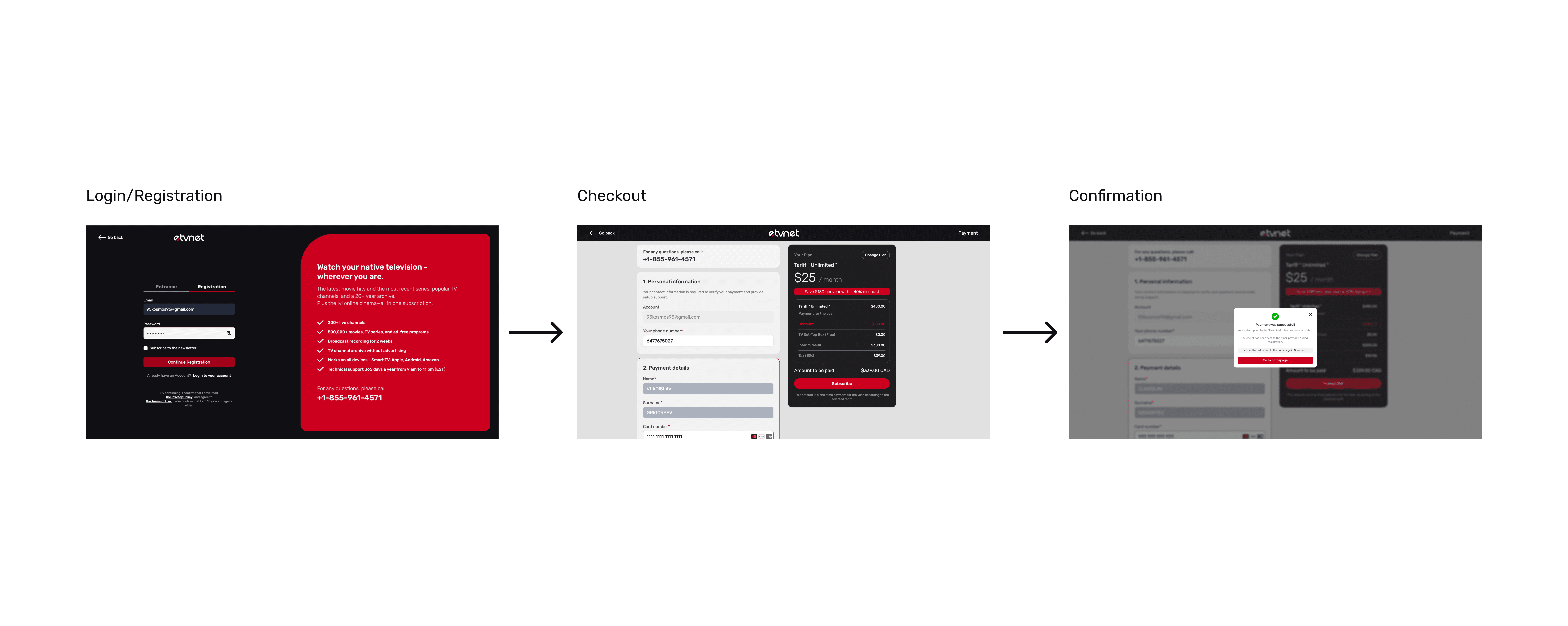
This transformed the journey into a clear and logical sequence:
Select a Plan → Register or Log In → Complete Payment
By reducing friction and preserving the user’s intent at every step, I made the registration and subscription process faster, easier, and more intuitive. The improved experience contributed to an increase in conversion rate.
Reminding a potential subscriber about our features
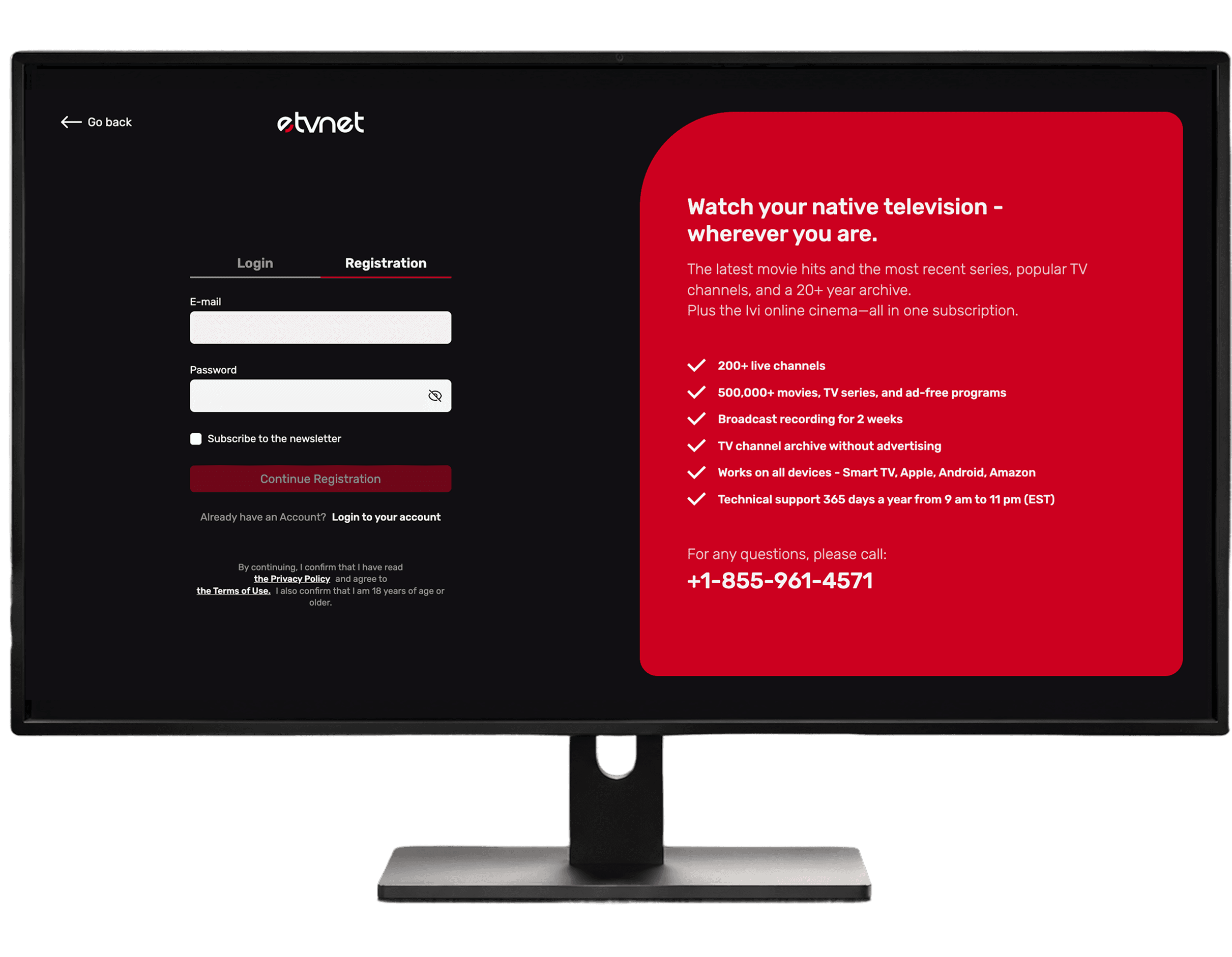
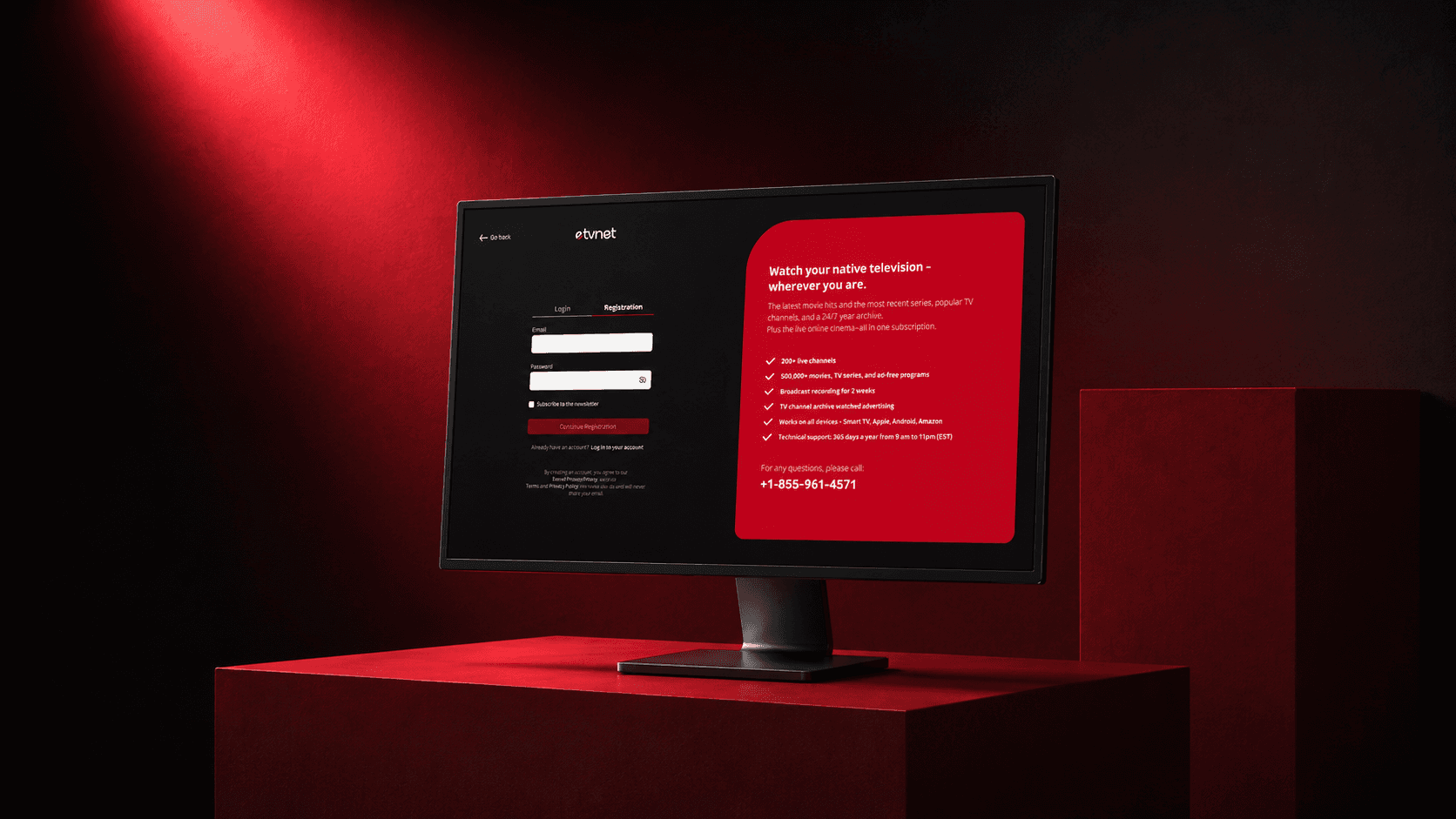
I also introduced a feature highlights panel on the registration screen. At this stage, users are already close to subscribing, so reinforcing the platform’s key benefits helped reassure potential customers of the value they were about to receive and encouraged them to proceed to checkout.
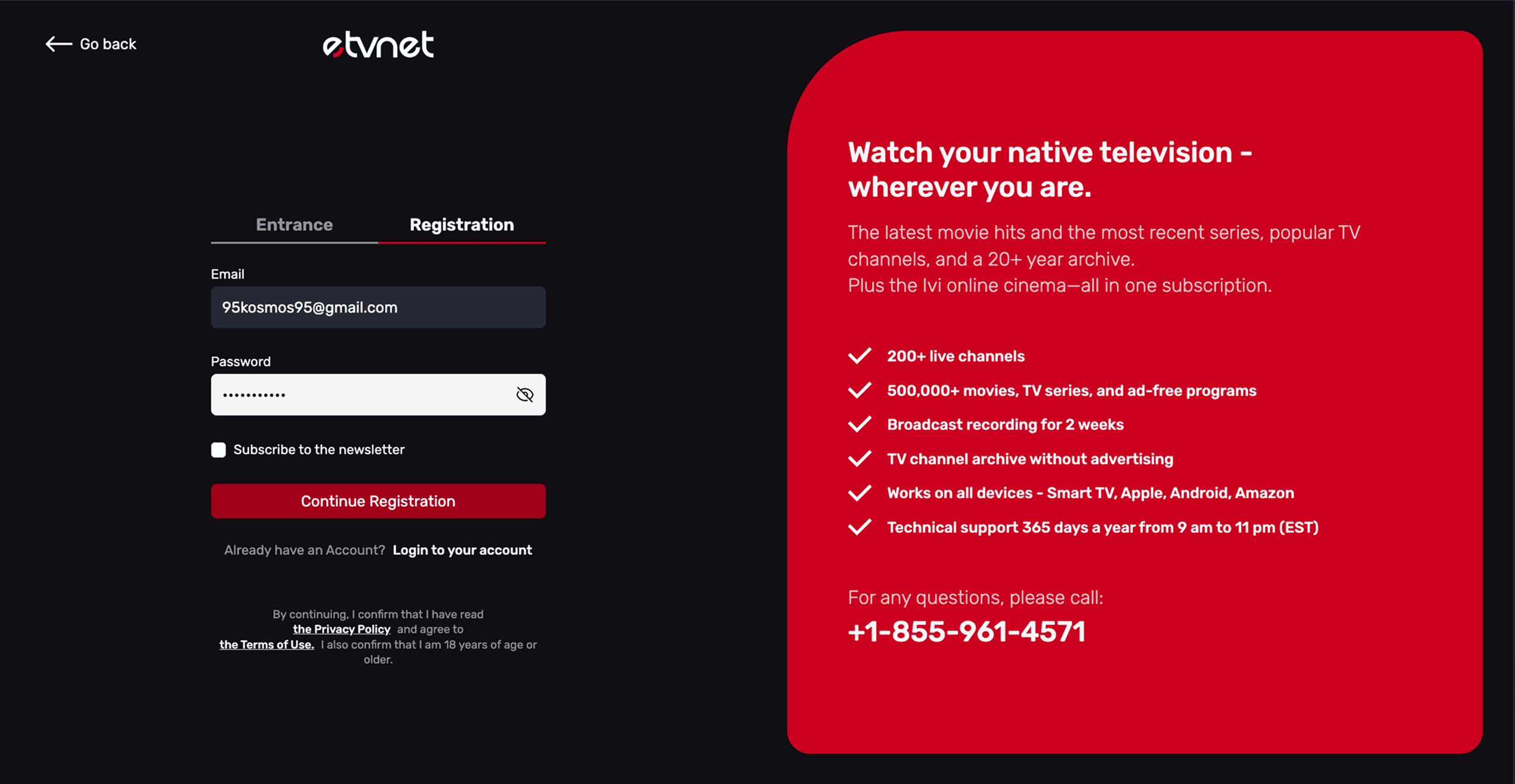
From a marketing and sales perspective, presenting the value proposition immediately before payment can reduce hesitation, justify the purchase decision, and increase the likelihood of conversion. In addition to that, I added our customer service phone number, so that a user could give us a call in case they still hesitate or have any questions.
Improved Checkout with customer support
I designed a standalone, isolated checkout page — a tunnel effect where the user has one clear path forward and one intentional exit. Everything else is removed.

The Outcomes
The redesigned subscription flow removed unnecessary friction at the most important conversion point: the moment a user had already selected a plan and was ready to pay. By preserving the chosen tariff, providing a clear registration path, and reinforcing the service value before checkout, the new experience delivered measurable business impact.
+7%
Increase in Conversion Rate
More users successfully progressed from selecting a subscription plan to completing their purchase
-25%
Decrease in Checkout Abandonment
Removing dead ends, repeated actions, and unexpected redirects reduced the number of users leaving the flow before payment.
What is eTVnet?
eTVnet is a subscription-based streaming platform that provides access to live TV channels, movies, TV series, and on-demand content primarily for Russian-speaking audiences worldwide. The service is available across web, mobile, Smart TV, and streaming devices, offering content from Russia, Ukraine, Belarus, Armenia, and other countries through a single subscription.
Who is it for?
eTVnet primarily serves Russian-speaking adults aged 50+, many of whom live outside their home countries and use the platform to stay connected with familiar language, culture, news, and entertainment. Unlike younger streaming audiences who actively discover new content, these users often seek a straightforward viewing experience centered around live television, recognizable programming, and easy access to their favorite channels.
As a result, simplicity, readability, trust, and ease of navigation play a critical role in the product experience. Many users have varying levels of technical proficiency, making intuitive interfaces, clear calls-to-action, and minimal friction essential for successful engagement.
I walked the flow as a first-time visitor
The brief was to improve subscription conversions. I started where any new customer would: opening the site, navigating to the pricing page, choosing a plan, and clicking Subscribe.
Within thirty seconds, I had the whole picture. An error modal appeared — not a registration prompt, not an invitation to create an account, just an error. It offered Login and Close. No register path. No guidance. No acknowledgment that I might be new to the product.
I ran the walkthrough several more times, as both a new user and an existing one. New users hit the same wall every time. Existing users could reach checkout — but only after an unexpected homepage redirect forced them to manually retrace their steps and re-select the plan they'd already chosen.
The product wasn't broken. The path through it was.
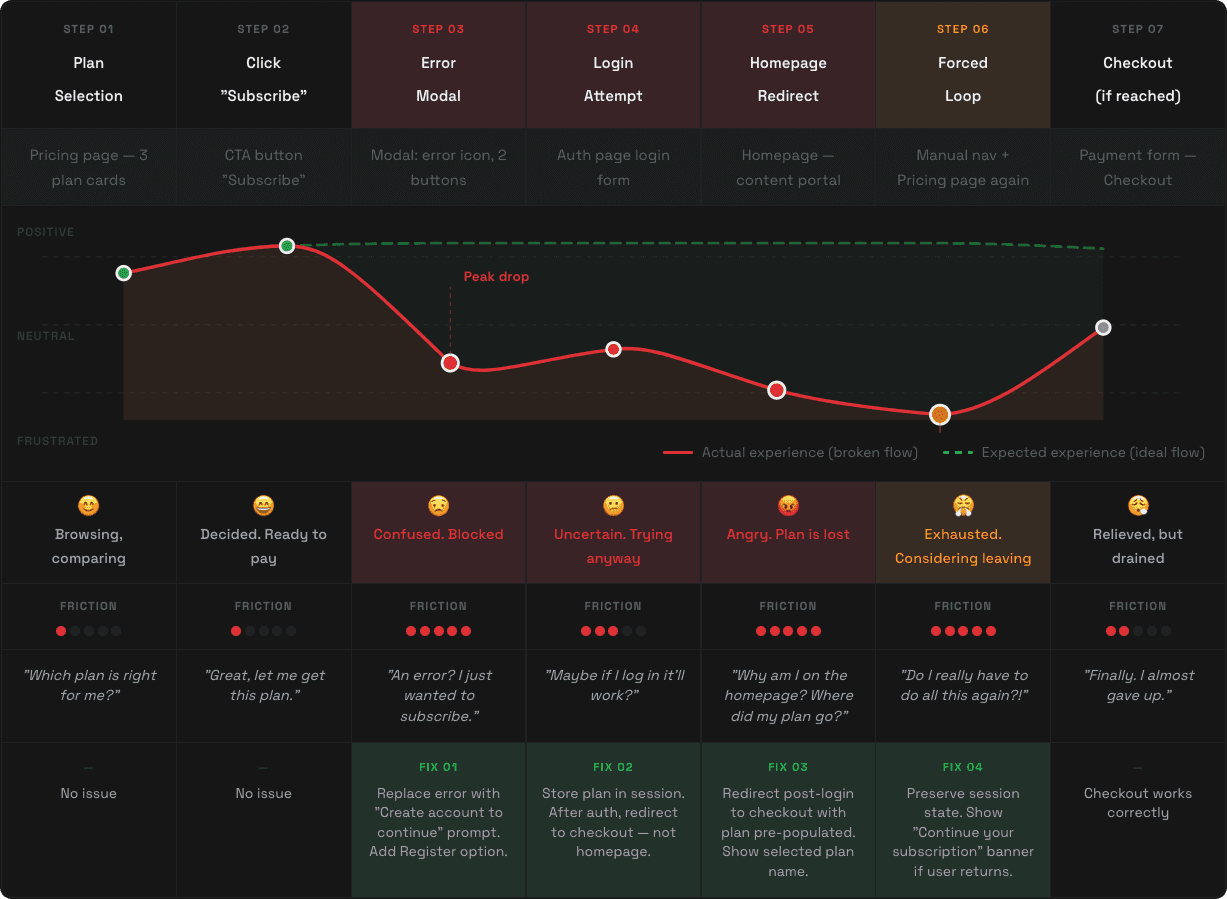
How frustration builds through the broken flow
Mapping each touchpoint against the user's emotional state, friction level, and the design opportunity it reveals.
The broken flow, screen by screen
What a motivated first-time buyer experiences when trying to subscribe.
Step 1 — Normal

The pricing page is the only part of
The pricing page is the only part of the flow that works as intended. Three plan tiers are clearly laid out with pricing, feature lists, and billing period options. A user reaching this page understands exactly what they're choosing and why.
The design builds confidence. That confidence is about to be destroyed.
Step 2 — First barrier

Error modal — the system wasn't built for them
The user clicks Select at peak purchase intent. The system responds with an error: "You must be authorized to continue."
For a new visitor, this message is incomprehensible. They haven't failed to do anything. The system simply wasn't designed to receive someone without an account. Login requires credentials they don't have. Close ends the flow entirely. There is no third option.
Step 3 — Broken redirect

Login succeeds — and immediately fails
An existing user enters their credentials and successfully authenticates. The system rewards them by sending them to the homepage — the content portal, entirely unrelated to checkout. Their plan selection has been silently discarded.
Expected: Select → Auth → Checkout. Actual: Select → Auth → Homepage. The user must now figure out, on their own, that they need to navigate back to Pricing and start again.
Step 4 — Forced loop
The user repeats the entire flow from scratch
The user manually navigates back to Pricing, finds the same plan, and clicks Subscribe for the second time. No prompt, no "continue where you left off," no indication from the system that anything went wrong — or that it already knows who they are.
Most users don't reach this step. Those who do are running on frustration and determination alone.
Step 5 — Destination

The checkout works — every step before it doesn't
The checkout form is well-built. Payment fields, order summary, billing details — all functional, all complete. A user who navigates here finishes the purchase. The product delivers what it promises.
The entire problem is the path to this screen, not the screen itself. That distinction matters: nothing in the backend needs to change. Only the connections between pieces that already exist.
Broken path vs. intended path
Decision points, barriers, and dead ends mapped as a flow — compared against the direct path the redesign enables.


Before:

After

The entire flow was significantly simplified and made straight forward.
The start of the solution
After identifying all existing issues in the global subscription flow, it was time to start working on a solution.
Me and my co-workers in the development team split the tasks so we could work simultaneously:
1. I started creating concepts of the screens that needed to be redesigned for this project (Registration/Login, Checkout).
2. The devs started fixing the flow in the backend. They started with the removal of the error message that would pop up for unauthorized users while attempting to select a plan. At the same time, they started moving the checkout section to a separate page.

Once the concepts were ready, we had a meeting we the stakeholders, to finalize the format and content for the Registration/Login page. Based on the received feedback I created a few high-fidelity mockups:


We had another review session with the stakeholders to approve the final concept, and we decided to stop on the simplified branded version:

The stakeholders wanted the information part be simple, branded, informative, yet not distracting. Therefore, this version was chosen.
Fixing the auth barrier wasn't enough
With the registration flow fixed, a user could finally reach checkout. But the checkout page itself had a second, quieter problem — one that didn't throw errors, but consistently pushed users out at the last moment.

Mental model mismatch
When a user selects a plan, they've entered "buying mode" and expect to land on a new screen — a context that signals now I'm completing a purchase. Instead, the page scrolled down to a payment form embedded within the Pricing page. The user never cognitively left the browsing experience.
Leaky funnel
Every navigation link visible during checkout was a potential exit. The site header — Archive, Movies, Search, Support contacts — stayed fully visible throughout payment. Any click, intentional or accidental, immediately ended the session. Baymard Institute research: removing navigation at checkout increases conversion by 15–30%.
No cognitive closure
Hick's Law: decision time increases with the number of available options. A checkout screen with full site navigation forces the brain to continuously evaluate irrelevant choices. The form also lacked visual hierarchy — the payment total sat to the right while the card input dominated left, with no linear sequence: What am I buying → Where do I pay → Confirm.
"A separate, clean checkout page is perceived as more secure and professional. An inline form embedded below a pricing table often feels less trustworthy for entering payment details."
A dedicated page with one purpose: complete the payment
I designed a standalone, isolated checkout page — a tunnel effect where the user has one clear path forward and one intentional exit. Everything else is removed.

I created a few concepts to find the most efficient solution, and after a review session with stakeholders I proceeded to work on the high-fidelity variations of the chosen format for the checkout screen.

When a pre-final concept was discussed and chosen, me and the dev mates conducted a few test sessions during which we identified minor that were later eliminated in the final version.

What changed and why
Decision 01 — Critical
Navigation removed entirely
The site header and footer are fully removed from the checkout page. The only available exit is a visible Back button at the top left — preserving the user's sense of control without providing accidental escape routes mid-payment.
Decision 02 — Critical
Two-column layout with persistent summary
Left column: three numbered form sections (Personal Info, Payment Data, Address) — a clear linear sequence. Right column: the order summary card remains visible at all times, showing plan name, discount breakdown, and total. The user never loses sight of what they're paying for. In addition to that, we put our customer service phone number at the top part of the form, in case a client needs any assistance with the payment.
Decision 03 — Important
Email pre-filled from auth session
After registration or login, the user's email is automatically carried into the checkout form. This reduces form friction at the highest-intent moment and reinforces continuity — the system already knows who they are, so they don't have to prove it again. site header and footer are fully removed from the checkout page. The only available exit is a visible Back button at the top left — preserving the user's sense of control without providing accidental escape routes mid-payment.
Decision 04 — Important
Change Plan option inside checkout
A "Change Plan" button is placed directly inside the order summary card. Users can revise their plan selection without navigating back to the Pricing page — keeping them within the checkout context and reducing abandonment during any last-moment reconsideration.
Two problems, one project, one principle
This project had two separate problems, discovered in sequence. The first was a hard blocker: new customers couldn't reach checkout at all. The second was subtler: the users who did reach checkout were being pulled out of buying mode by a page that was still in browsing mode.
Both failures had the same root cause — the flow was designed and tested exclusively from the perspective of a returning user. Everything worked for them. New customers were never in the scenario. The checkout page worked for users who already knew where it was and why they were there. It failed everyone arriving at a moment of high intent but low familiarity.
The auth barrier required one new button and two logic changes. The checkout redesign required a dedicated page and a new layout. Neither required new features, new backend, or new content. Both required following the user's actual journey end-to-end — which had simply never been done.
That's the lesson that runs through both fixes: a product can be technically complete and commercially broken at the same time. The gap is always between how the team tests it and how a new customer actually experiences it.
"A product can be technically complete and commercially broken at the same time. The gap lives between how the team tests it and how a first-time user actually experiences it."
Next Steps
Step 1
Homepage Redesign
The subscription flow now works end-to-end — but for many users, the decision to subscribe is made, or lost, before they ever reach the Plans page. The eTVnet homepage is the first impression for the Russian-speaking diaspora: people who moved abroad and are looking for a connection to language, culture, and home. Right now the homepage doesn't carry that weight. The value proposition isn't immediate, there's no social proof, and the visual language doesn't speak to the audience it serves. A redesigned homepage needs to build conviction before the user even sees a plan — so that when they click Subscribe, they're already sold.
Step 2
Plans Page Redesign
The Plans page is where subscription intent is formed — and where clarity directly determines revenue. The current page lists three tiers but doesn't make the decision easy. The 40% annual saving is present but not featured. The plan names don't intuitively describe what each includes. And there's no visual signal pointing to the recommended option. A user arriving on this page should leave it with confidence, not questions. The redesign needs to make the value obvious at a glance, surface the savings prominently, and guide the user to the CTA without hesitation — so the checkout process carries zero persuasion burden.
.say hello